
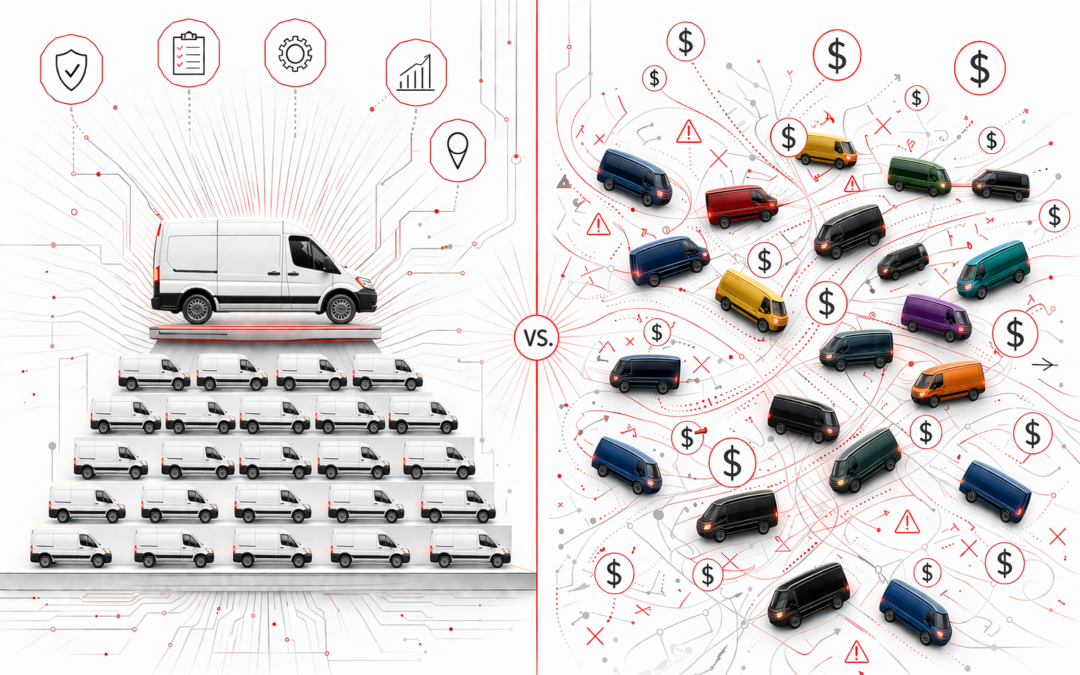
When you walk into almost any national retail chain, you’ll probably find the same fire protection model:
- A mix of regional vendors
- Longstanding local relationships
- Different contracts, schedules, and service standards
This didn’t start as a strategy but has accumulated over time—store by store, region by region. And for a while, it works. Until it doesn’t. On paper, using multiple vendors feels flexible—even cost-effective. In practice, it creates a different kind of cost structure—one that rarely shows up on a spreadsheet. Because the real cost isn’t in the service line item, it’s in what happens between the lines.
Ask a retail facilities leader managing 50, 100, or 200 locations if all of their stores are compliant right now, and if they’re using a multi-vendor model, the answer is usually, “We think so.” The problem is that with this model, each vendor provides their own:
- Reports
- Formats
- Timelines
- Definitions of “complete”
There’s no single source of truth—only a patchwork of partial visibility and that’s where risk lives. Not because vendors are bad—but because they’re different. Different technicians interpret conditions differently. Different companies prioritize issues differently. Different regions enforce codes differently.
What you end up with is not a unified fire protection program but 50+ variations of one and over time, those variations create uneven compliance, missed deficiencies and repeated violations across locations
This is the cost that facilities teams feel every day—but rarely quantify. Managing multiple vendors means:
- Coordinating different schedules across regions
- Chasing down reports in different formats
- Reconciling invoices across providers
- Following up on unresolved issues manually
None of this improves compliance. But all of it consumes time. And there is a compounding effect of small failures. In retail environments, most fire safety issues are not catastrophic:
- A missed inspection
- An unresolved trouble signal
- A blocked sprinkler head
- An expired extinguisher tag
They’re small and, individually, they’re easy to fix but at scale, across dozens of locations, they become patterns. And patterns become failed inspections, emergency service calls, fines and brand risk, which is also known as Brand Uptime.
The Illusion of Cost Savings with the Multi-Vendor model
At a store level, a local fire protection vendor might appear less expensive. But zoom out across the entire portfolio, and the picture changes.
The true cost includes iInternal labor managing vendors, redundant inspections or missed service cycles, reactive repairs instead of planned maintenance and compliance failures and penalties. What looked like savings becomes uncontrolled spend.
The most sophisticated retail operators are making a shift from vendors to infrastructure. Instead of asking, “Who services our stores?” they are asking, “How is compliance managed across our entire portfolio?” This is a fundamentally different mindset.
Technology Changes the Equation: A System for Visibility and Validation
Even with a single partner, one challenge still remains: How do you actually see what’s happening across every location—without relying on fragmented reports or manual follow-up? This is where most fire protection programs break down because compliance isn’t just about service being performed, it’s about service being verified, documented, and visible—at scale.
How RAEL-REDi Supports Multi-Site Compliance
To solve this, RAEL developed RAEL-REDi—a technology platform designed to bring structure, visibility, and validation to your fire protection program across multi-location portfolios. At its core, RAEL-REDi connects three things that are typically disconnected:
- The asset (equipment in the field)
- The service performed (inspection, testing, maintenance)
- The documentation (proof of compliance)
What That Means in Practice:
1. Asset-Level Visibility Across Every Location
Each piece of fire protection equipment is digitally tracked and tagged.
Facilities teams can quickly see:
- What equipment exists at each site
- When it was last serviced
- What condition it’s in
No more relying on static reports or outdated spreadsheets.
2. Real-Time Service Validation
Service isn’t just reported—it’s verified.
Each inspection or service event is tied directly to the asset, with:
- Time-stamped activity
- Technician validation
- Supporting documentation
This creates a clear record of what was actually completed—not just what was scheduled.
3. Centralized Compliance Tracking
Instead of chasing updates across vendors or locations, teams have a centralized view of:
- Inspection status across all sites
- Open deficiencies
- Completed vs. pending work
Which makes it possible to answer, with confidence: “Are we compliant right now?”
4. Standardized Documentation for Every Location
Reports are no longer inconsistent, delayed or difficult to access. With RAEL-REDi they’re structured, consistent, and available when needed—for audits, inspections, or internal reporting. This matters for retail operators because, At scale, the biggest risk isn’t that service isn’t happening, it’s that you can’t prove it, track it, or compare it consistently across locations.
RAEL-REDi closes that gap because it transforms fire protection from a reactive, report-driven process into a continuous, trackable compliance system
When you combine a single national partner, standardized service delivery, and a system like RAEL-REDi, you’re no longer managing vendors.you’re operating a compliance infrastructure. And once that infrastructure is in place, the question becomes less about fixing individual issues—and more about how effectively your entire system is performing.
When It’s Time to Rethink Your Model
Not every organization needs to change but if you’re managing:
- 20+ locations
- Multiple states
- Multiple vendors
- Inconsistent reporting
…it’s worth asking a different question.
Not:
“What are we paying each vendor?”
But:
“What is inconsistency costing us across the system?”
Most organizations don’t realize their model is broken until an inspection fails across multiple locations, a pattern of violations emerges, or leadership starts asking for answers no one can quickly provide. By then, the cost isn’t theoretical, it’s operational.
A better way to think about it is that fire protection at scale isn’t a vendor problem, i’s a systems problem. And the organizations that solve it that way don’t just reduce risk—they gain control.
Rethinking Your Fire Protection Model?
If you’re managing fire protection across multiple locations and starting to question whether your current approach is scalable, it may be time for a different conversation.
RAEL works with multi-site operators to bring structure, visibility, and consistency to fire protection—through a unified service model and platforms like RAEL-REDi.
Contact us to start a conversation about what a more scalable approach could look like for your organization.
Recent Comments